Want more people to find your business when they search? That’s search marketing.
It can sound complicated, but it isn’t. We’ve broken it into seven simple stages, so you can see where you are and what to do next.
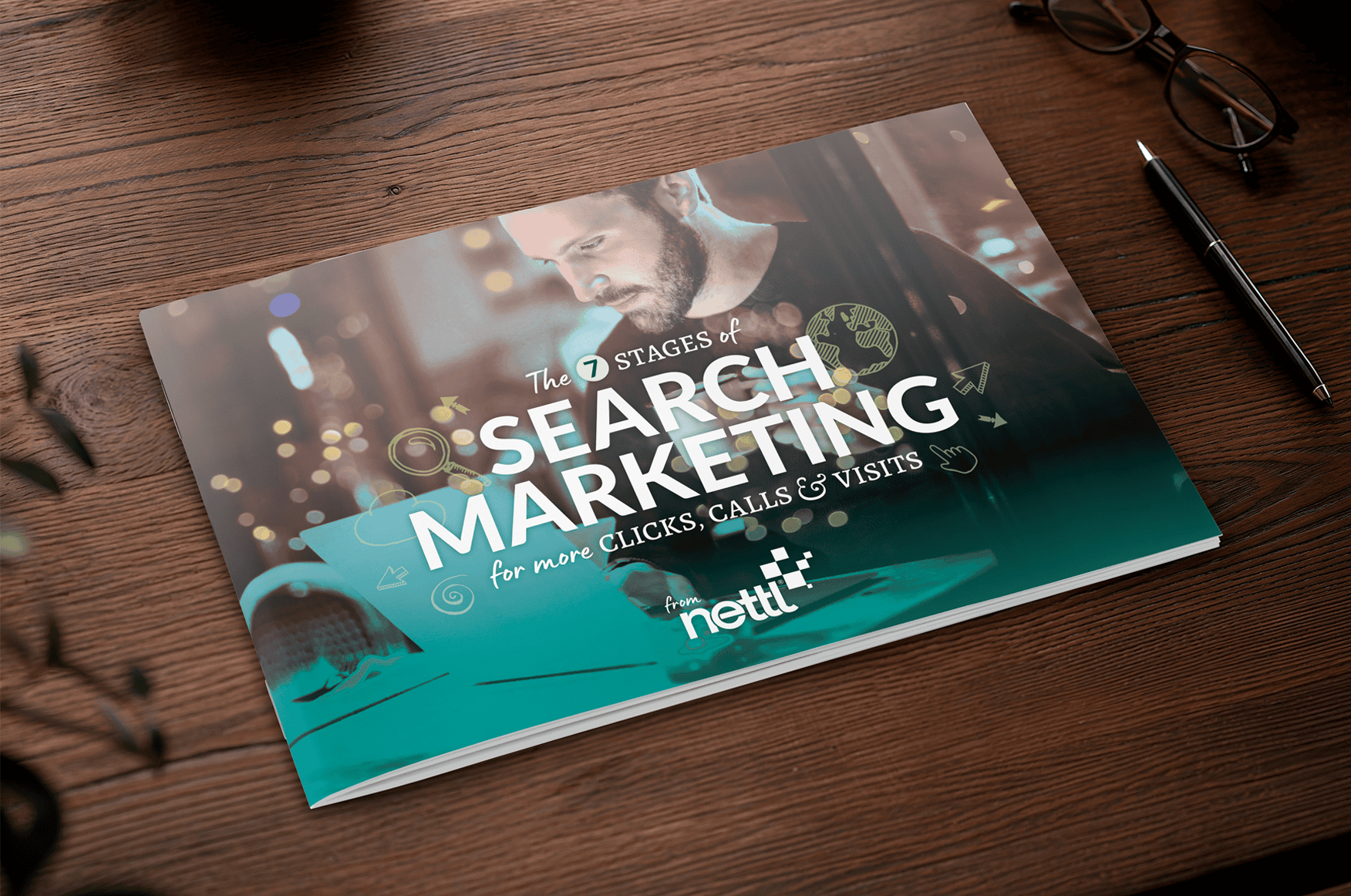
Prefer to read it on the go? You can download our free 7 Stages of SEO brochure.
What is search marketing?
Search marketing gets your business seen when people look for what you do, on Google and in AI answers.
That means ranking in search results and being named in tools like Google’s AI Overviews, ChatGPT and Gemini, which now summarise the options and recommend businesses directly.
Google still handles 91% of UK searches, and its AI Overviews reach 2.5 billion people a month. Ranking well on Google remains the foundation for both.
Stage 1: Audit
Not sure where to begin? Start with a free audit. We’ll look at:
- Page structure and technical setup
- Keyword use
- Responsiveness and usability
- Speed and security
- Visibility in AI answers
Stage 2: Keywords
Keyword research is the compass for search marketing. We find the words your customers type into Google, plus the longer questions they ask AI tools like ChatGPT.
We weigh up search volume, relevance, intent and how realistic it is to rank. That shows us where the best opportunities are and what to tackle first.
Stage 3: Content
Google won’t rank a site that never says what it does. And AI tools can’t quote a business that doesn’t answer the question.
Your website should be on-brand, mobile-friendly and fast, with easy navigation and clear calls to action. Dedicated landing pages then answer specific questions clearly enough for customers to act on.
Stage 4: Onsite SEO
Now search engines and AI tools need to read your site, understand it and trust it. Onsite SEO handles relevance. Ask yourself:
- Can Google and AI tools easily read your website?
- Is your content high quality, relevant, unique and useful?
- Is your site technically and structurally sound?
- Does it look good and load quickly on every device?
- Does it use structured data, so search engines understand your business?
Stage 5: Offsite SEO
Once your site is solid, it’s time to build authority. Backlinks remain one of the strongest signals in SEO, and a link from a respected site works like a personal recommendation.
Good links can mean better rankings and referral traffic. They also help AI tools build their picture of your business, because they learn from what the rest of the web says about you.
Spammy, low-quality links can hold you back, so quality matters more than quantity.
If customers look for you locally, your Google Business Profile matters too. Keep every section complete, add fresh photos, ask for reviews and reply to them, and keep your details consistent everywhere.
Stage 6: AI SEO
People now ask AI tools full questions, with context, and get a shortlist of businesses back. AI SEO helps you appear in those answers, as a mention, a recommendation or a cited link.
It builds on everything above, then adds:
- Answer-first content in short sections AI can quote
- FAQs and structured data that spell out who you are and what you do
- Pages AI crawlers can read, with nothing hidden behind scripts or pop-ups
- Brand mentions and reviews on other trusted sites
Stage 7: PPC (optional)
Need fast results? SEO takes time, but ads can start driving traffic straight away. Pay-per-click can give you a head start, and works well alongside SEO or on its own.
Where are you on the journey?
Search marketing is never finished. It’s continuous improvement, so the best place to start is wherever you are today.
Ready to see the full picture? Download our free 7 Stages of SEO brochure.
Want a hand? Chat to us. Come and see us at our studio on Blake Street, call 01904 501 524, or get in touch online. We’ll work out which stages will make the biggest difference for you.